
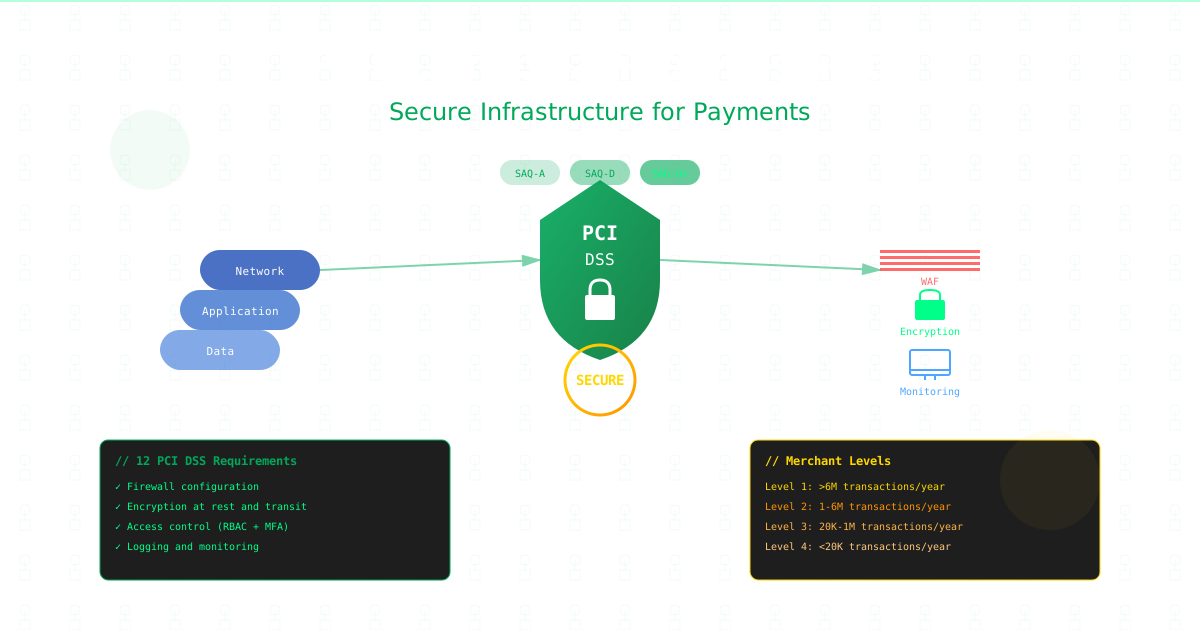
Processing credit card payments online requires more than just a payment gateway - it demands a hosting infrastructure that supports PCI DSS (Payment Card Industry Data Security Standard) compliance. With data breaches costing an average of $4.88 million in 2024, choosing the right hosting platform is critical for protecting cardholder data. This guide helps you evaluate hosting providers and understand what features support PCI compliance efforts.
Understanding PCI DSS Hosting Requirements
PCI DSS isn’t just a checkbox - it’s a comprehensive security framework that affects every aspect of your hosting infrastructure. Understanding these requirements is the first step in choosing appropriate hosting.
The 12 PCI DSS Requirements and Hosting Implications
1. Install and Maintain Network Security Controls
- Firewall configuration
- DMZ implementation
- Network segmentation
- Traffic monitoring
2. Apply Secure Configurations
- Default password changes
- Unnecessary service removal
- Security parameter configuration
- System hardening
3. Protect Stored Account Data
- Encryption at rest
- Data retention policies
- Secure deletion
- Key management
4. Protect Cardholder Data with Cryptography During Transmission
- TLS/SSL implementation
- Strong cryptography
- Certificate management
- Secure protocols only
5. Protect Systems and Networks from Malicious Software
- Anti-virus/anti-malware
- Regular updates
- System monitoring
- Patch management
6. Develop and Maintain Secure Systems
- Vulnerability management
- Security patches
- Change control
- Secure development
7. Restrict Access by Business Need-to-Know
- Role-based access
- Least privilege principle
- Access reviews
- Permission management
8. Identify Users and Authenticate Access
- Unique user IDs
- Strong authentication
- Multi-factor authentication
- Password policies
9. Restrict Physical Access
- Data center security
- Access controls
- Visitor management
- Media disposal
10. Log and Monitor All Access
- Audit logging
- Log retention
- Daily review
- Centralized logging
11. Test Security Regularly
- Vulnerability scanning
- Penetration testing
- File integrity monitoring
- Security assessments
12. Support Information Security with Organizational Policies
- Security policies
- Risk assessments
- Incident response
- Security awareness
Hosting Features That Support PCI Compliance
Essential Security Infrastructure
# pci-hosting-requirements.yaml
infrastructure_requirements:
  network_security:
    firewall:
      type: [waf, network_firewall]
      configuration: stateful
      rules: customizable
      logging: comprehensive

    network_segmentation:
      capability: required
      implementation: [vlan, vpc, subnet]
      isolation: complete

    intrusion_detection:
      ids: required
      ips: recommended
      alerts: real_time

  data_protection:
    encryption_at_rest:
      algorithm: aes_256
      key_management: hsm_backed
      scope: all_storage

    encryption_in_transit:
      protocols: [tls_1_2, tls_1_3]
      cipher_suites: strong_only
      certificate_management: automated

    backup_encryption:
      required: true
      key_separation: mandatory

  access_control:
    authentication:
      mfa: required
      sso: supported
      password_complexity: enforced

    authorization:
      rbac: required
      privilege_escalation: monitored
      access_reviews: automated

    api_security:
      authentication: token_based
      rate_limiting: required
      audit_logging: comprehensive
Compliance Support Features
What to Look for in PCI-Supportive Hosting:
# pci-hosting-evaluator.py
class PCIHostingEvaluator:
    def evaluate_provider(self, provider_features):
        """
        Evaluate if a hosting provider can support PCI compliance efforts.
        Note: The provider doesn't make you compliant - implementation does.
        """

        evaluation = {
            'network_security': self.check_network_features(provider_features),
            'data_protection': self.check_encryption_capabilities(provider_features),
            'access_control': self.check_access_management(provider_features),
            'monitoring': self.check_monitoring_capabilities(provider_features),
            'compliance_tools': self.check_compliance_support(provider_features),
            'documentation': self.check_documentation_quality(provider_features)
        }

        score = sum(evaluation.values()) / len(evaluation) * 100

        return {
            'provider': provider_features['name'],
            'pci_support_score': score,
            'strengths': self.identify_strengths(evaluation),
            'gaps': self.identify_gaps(evaluation),
            'recommendation': self.make_recommendation(score),
            'note': 'Provider features support compliance; proper implementation is your responsibility'
        }

    def check_network_features(self, features):
        required = ['firewall', 'network_segmentation', 'ddos_protection', 'ids_ips']
        return len([f for f in required if f in features]) / len(required)

    def check_encryption_capabilities(self, features):
        required = ['encryption_at_rest', 'encryption_in_transit', 'key_management', 'hsm_support']
        return len([f for f in required if f in features]) / len(required)
PCI Compliance Levels and Hosting Needs
Understanding Merchant Levels
Level 1: >6 Million Transactions Annually
- Most stringent requirements
- Annual on-site assessment
- Quarterly network scans
- Dedicated security team needed
Hosting Requirements:
level_1_hosting:
  infrastructure:
    - dedicated_servers_or_private_cloud
    - complete_network_isolation
    - redundant_security_controls
    - 24x7_monitoring

  features:
    - hardware_security_modules
    - dedicated_firewall_appliances
    - real_time_security_monitoring
    - automated_compliance_reporting

  support:
    - 24x7_security_team
    - incident_response_sla
    - compliance_expertise
    - audit_assistance
Level 2: 1-6 Million Transactions
- Annual self-assessment
- Quarterly network scans
- Less complex infrastructure acceptable
Level 3: 20,000-1 Million Transactions
- Annual self-assessment
- Quarterly network scans
- Standard security measures
Level 4: <20,000 Transactions
- Annual self-assessment
- Quarterly network scans (maybe)
- Basic security sufficient
SAQ Types and Hosting Implications
# saq-hosting-requirements.py
def determine_saq_hosting_needs(saq_type):
    """
    Determine hosting requirements based on SAQ type
    """

    requirements = {
        'SAQ_A': {
            'description': 'Fully outsourced, redirect to payment processor',
            'hosting_needs': {
                'complexity': 'minimal',
                'pci_scope': 'none',
                'special_requirements': [],
                'recommended_hosting': 'any_secure_hosting'
            }
        },
        'SAQ_A_EP': {
            'description': 'E-commerce, partially outsourced',
            'hosting_needs': {
                'complexity': 'moderate',
                'pci_scope': 'partial',
                'special_requirements': [
                    'secure_web_hosting',
                    'ssl_certificates',
                    'vulnerability_scanning'
                ],
                'recommended_hosting': 'pci_ready_hosting'
            }
        },
        'SAQ_D': {
            'description': 'Direct payment processing',
            'hosting_needs': {
                'complexity': 'high',
                'pci_scope': 'full',
                'special_requirements': [
                    'network_segmentation',
                    'waf',
                    'ids_ips',
                    'log_management',
                    'file_integrity_monitoring'
                ],
                'recommended_hosting': 'pci_compliant_infrastructure'
            }
        }
    }

    return requirements.get(saq_type)
Evaluating Hosting Providers for PCI Support
Key Questions to Ask Providers
Infrastructure Security:
- Do you provide network segmentation capabilities?
- Is a Web Application Firewall (WAF) included?
- What DDoS protection is available?
- How is physical security maintained?
Data Protection:
- What encryption options are available?
- How are encryption keys managed?
- Is Hardware Security Module (HSM) support available?
- What backup encryption is provided?
Access Control:
- What authentication methods are supported?
- Is role-based access control available?
- How are privileged accounts managed?
- What audit logging is provided?
Compliance Support:
- Do you provide PCI compliance attestations?
- What compliance tools are included?
- Is vulnerability scanning available?
- Can you provide audit support?
Red Flags to Avoid
# pci-hosting-red-flags.py
def identify_pci_hosting_risks(provider_info):
    """
    Identify potential risks in hosting providers for PCI compliance
    """

    red_flags = []

    # Security red flags
    if not provider_info.get('firewall'):
        red_flags.append('No firewall capabilities mentioned')

    if not provider_info.get('encryption_at_rest'):
        red_flags.append('No encryption at rest')

    if provider_info.get('shared_hosting'):
        red_flags.append('Shared hosting not suitable for PCI')

    # Compliance red flags
    if 'pci_compliant' in provider_info.get('marketing_claims', []):
        red_flags.append('Claims to make you PCI compliant (misleading)')

    if not provider_info.get('audit_logs'):
        red_flags.append('No audit logging capabilities')

    # Operational red flags
    if not provider_info.get('24x7_support'):
        red_flags.append('No 24x7 support for incidents')

    if not provider_info.get('backup_plan'):
        red_flags.append('No clear backup/recovery plan')

    return {
        'risk_level': 'high' if len(red_flags) > 3 else 'medium' if len(red_flags) > 0 else 'low',
        'red_flags': red_flags,
        'recommendation': 'avoid' if len(red_flags) > 3 else 'proceed_with_caution'
    }
Cloud Providers and PCI Compliance Support
Major Cloud Platforms Assessment
AWS (Amazon Web Services)
aws_pci_support:
  certifications:
    - pci_dss_level_1_service_provider
    - iso_27001
    - soc_2

  pci_services:
    compute:
      - ec2_dedicated_instances
      - vpc_network_isolation
      - security_groups

    storage:
      - s3_encryption
      - ebs_encryption
      - kms_key_management

    security:
      - waf
      - shield_ddos_protection
      - cloudtrail_audit_logs
      - config_compliance_monitoring

  responsibility_model:
    aws_responsible_for:
      - physical_security
      - hypervisor_security
      - network_infrastructure

    you_responsible_for:
      - os_configuration
      - application_security
      - data_encryption_implementation
      - access_management
Google Cloud Platform
gcp_pci_support:
  certifications:
    - pci_dss_level_1
    - iso_27001
    - soc_2_type_2

  pci_services:
    - vpc_service_controls
    - cloud_armor_waf
    - cloud_kms
    - cloud_audit_logs
    - dlp_api

  strengths:
    - encryption_by_default
    - strong_network_isolation
    - comprehensive_audit_logs

  considerations:
    - complex_initial_setup
    - requires_gcp_expertise
Azure
azure_pci_support:
  certifications:
    - pci_dss_level_1
    - multiple_compliance_certifications

  pci_services:
    - azure_firewall
    - key_vault
    - security_center
    - sentinel_siem
    - policy_compliance

  advantages:
    - integrated_compliance_tools
    - automated_compliance_assessment
    - strong_enterprise_features
Specialized PCI Hosting Providers
Managed PCI Hosting Characteristics:
- Pre-configured PCI environments
- Compliance tool bundles
- Expert support teams
- Regular compliance updates
- Audit assistance
Evaluation Criteria:
def evaluate_specialized_provider(provider):
    criteria = {
        'infrastructure': {
            'dedicated_environment': 10,
            'network_segmentation': 10,
            'redundant_controls': 5
        },
        'compliance_tools': {
            'vulnerability_scanning': 10,
            'log_management': 10,
            'file_integrity_monitoring': 5
        },
        'support': {
            'pci_expertise': 10,
            'audit_assistance': 10,
            '24x7_security': 10
        },
        'cost_effectiveness': {
            'transparent_pricing': 5,
            'included_features': 10,
            'no_hidden_costs': 5
        }
    }

    score = calculate_weighted_score(provider, criteria)
    return {
        'provider': provider['name'],
        'pci_readiness_score': score,
        'recommendation': get_recommendation(score)
    }
Building PCI-Compliant Architecture
Network Architecture for PCI
# pci-network-architecture.yaml
pci_network_design:
  dmz_zone:
    purpose: public_facing_services
    components:
      - load_balancers
      - web_servers
      - waf
    security:
      - strict_ingress_rules
      - no_direct_database_access
      - ssl_termination

  application_zone:
    purpose: business_logic
    components:
      - application_servers
      - api_servers
      - message_queues
    security:
      - limited_dmz_access
      - encrypted_internal_communication
      - service_authentication

  data_zone:
    purpose: cardholder_data_storage
    components:
      - database_servers
      - backup_systems
      - key_management
    security:
      - maximum_isolation
      - encryption_mandatory
      - audit_everything

  management_zone:
    purpose: administration
    components:
      - jump_servers
      - monitoring_systems
      - log_collectors
    security:
      - mfa_required
      - session_recording
      - time_limited_access
Implementation Best Practices
# pci-implementation-checklist.py
class PCIImplementationGuide:
    def __init__(self):
        self.checklist = []

    def pre_deployment_checklist(self):
        return [
            {
                'task': 'Document data flows',
                'description': 'Map how cardholder data moves through systems',
                'priority': 'critical'
            },
            {
                'task': 'Implement network segmentation',
                'description': 'Isolate CDE from other networks',
                'priority': 'critical'
            },
            {
                'task': 'Configure firewalls',
                'description': 'Implement strict ingress/egress rules',
                'priority': 'critical'
            },
            {
                'task': 'Enable encryption',
                'description': 'Encrypt data at rest and in transit',
                'priority': 'critical'
            },
            {
                'task': 'Set up logging',
                'description': 'Configure comprehensive audit logging',
                'priority': 'critical'
            },
            {
                'task': 'Implement access controls',
                'description': 'Configure RBAC and MFA',
                'priority': 'critical'
            },
            {
                'task': 'Deploy monitoring',
                'description': 'Set up security monitoring and alerts',
                'priority': 'high'
            },
            {
                'task': 'Configure backups',
                'description': 'Implement encrypted backup strategy',
                'priority': 'high'
            },
            {
                'task': 'Document procedures',
                'description': 'Create security and incident response procedures',
                'priority': 'high'
            },
            {
                'task': 'Train staff',
                'description': 'Ensure team understands PCI requirements',
                'priority': 'medium'
            }
        ]
Security Controls Implementation
Web Application Firewall (WAF) Configuration
# waf-rules-pci.conf
# Example ModSecurity rules for PCI compliance

# Block SQL injection attempts
SecRule REQUEST_URI|ARGS|REQUEST_BODY "@detectSQLi" \
    "id:1001,\
    phase:2,\
    block,\
    msg:'SQL Injection Attack Detected',\
    logdata:'Matched Data: %{MATCHED_VAR} found within %{MATCHED_VAR_NAME}',\
    severity:'CRITICAL',\
    tag:'PCI_DSS_6.5.1'"

# Block XSS attempts
SecRule REQUEST_URI|ARGS|REQUEST_BODY "@detectXSS" \
    "id:1002,\
    phase:2,\
    block,\
    msg:'XSS Attack Detected',\
    severity:'CRITICAL',\
    tag:'PCI_DSS_6.5.7'"

# Restrict HTTP methods
SecRule REQUEST_METHOD "!@within GET POST HEAD" \
    "id:1003,\
    phase:1,\
    block,\
    msg:'Method not allowed',\
    severity:'WARNING',\
    tag:'PCI_DSS_2.3'"

# Block access to sensitive files
SecRule REQUEST_URI "@contains /admin" \
    "id:1004,\
    phase:1,\
    block,\
    msg:'Admin access attempted',\
    chain"
    SecRule REMOTE_ADDR "!@ipMatch 10.0.0.0/8"
Encryption Implementation
# encryption-implementation.py
from cryptography.fernet import Fernet
from cryptography.hazmat.primitives import hashes
from cryptography.hazmat.primitives.kdf.pbkdf2 import PBKDF2
import os

class PCIEncryption:
    def __init__(self, master_key=None):
        self.master_key = master_key or os.environ.get('MASTER_KEY')

    def encrypt_card_number(self, card_number):
        """
        Encrypt credit card number for storage
        PCI DSS Requirement 3.4
        """
        # Tokenization is preferred over encryption
        if self.should_use_tokenization():
            return self.tokenize(card_number)

        # If encryption is necessary
        fernet = Fernet(self.get_data_encryption_key())
        encrypted = fernet.encrypt(card_number.encode())

        # Store only if absolutely necessary
        return {
            'encrypted_data': encrypted,
            'key_version': self.get_key_version(),
            'algorithm': 'AES-256',
            'storage_duration': 'minimum_required'
        }

    def implement_key_rotation(self):
        """
        Implement cryptographic key rotation
        PCI DSS Requirement 3.6
        """
        rotation_schedule = {
            'encryption_keys': 'annually',
            'signing_keys': 'every_2_years',
            'master_keys': 'every_3_years',
            'compromised_keys': 'immediately'
        }
        return rotation_schedule
Logging and Monitoring
# pci-logging-requirements.yaml
logging_configuration:
  what_to_log:
    - user_access_to_cardholder_data
    - all_administrator_actions
    - access_to_audit_logs
    - invalid_access_attempts
    - use_of_identification_auth
    - initialization_of_audit_logs
    - creation_modification_of_system_objects

  log_details:
    - user_identification
    - type_of_event
    - date_and_time
    - success_or_failure
    - origination_of_event
    - identity_of_affected_component

  retention:
    minimum: 1_year
    readily_available: 3_months

  protection:
    - centralized_logging
    - log_integrity_monitoring
    - access_control_to_logs
    - encryption_of_logs
    - backup_of_logs
Cost Considerations for PCI Hosting
Total Cost of PCI Compliance Hosting
# pci-hosting-cost-calculator.py
def calculate_pci_hosting_costs(level, transaction_volume):
    """
    Calculate total costs for PCI-compliant hosting
    """

    # Base infrastructure costs
    infrastructure = {
        'level_1': {
            'hosting': 5000,  # Dedicated infrastructure
            'firewall': 500,
            'waf': 300,
            'monitoring': 400,
            'backup': 200
        },
        'level_2': {
            'hosting': 2000,
            'firewall': 200,
            'waf': 200,
            'monitoring': 200,
            'backup': 100
        },
        'level_3_4': {
            'hosting': 500,
            'firewall': 100,
            'waf': 100,
            'monitoring': 100,
            'backup': 50
        }
    }

    # Compliance tools costs
    compliance_tools = {
        'vulnerability_scanning': 200,
        'log_management': 300,
        'file_integrity': 150,
        'security_training': 100
    }

    # Assessment costs
    assessment = {
        'level_1': 15000,  # Annual on-site assessment
        'level_2': 3000,   # Annual SAQ + scanning
        'level_3_4': 500   # Annual SAQ
    }

    monthly_cost = sum(infrastructure[level].values()) + sum(compliance_tools.values())
    annual_cost = (monthly_cost * 12) + assessment[level]

    return {
        'monthly_infrastructure': monthly_cost,
        'annual_assessment': assessment[level],
        'total_annual': annual_cost,
        'per_transaction': annual_cost / transaction_volume if transaction_volume > 0 else 0
    }
ROI of Proper PCI Hosting
def calculate_pci_roi(compliant_hosting_cost, breach_risk):
    """
    Calculate ROI of investing in PCI-compliant hosting
    """

    # Average breach costs (2024 data)
    breach_costs = {
        'average_breach': 4880000,
        'per_record': 165,
        'legal_fees': 500000,
        'regulatory_fines': 1000000,
        'reputation_damage': 2000000,
        'operational_disruption': 800000
    }

    # Risk reduction with compliant hosting
    risk_reduction = 0.85  # 85% reduction in breach risk

    # Calculate potential savings
    potential_loss = breach_costs['average_breach'] * breach_risk
    reduced_risk_loss = potential_loss * (1 - risk_reduction)
    savings = potential_loss - reduced_risk_loss

    roi = ((savings - compliant_hosting_cost) / compliant_hosting_cost) * 100

    return {
        'investment': compliant_hosting_cost,
        'potential_savings': savings,
        'roi_percentage': roi,
        'payback_period_months': (compliant_hosting_cost / (savings / 12))
    }
Common PCI Hosting Mistakes to Avoid
Configuration Errors
1. Storing Sensitive Data Unnecessarily
# What NOT to do
def bad_practice():
    # NEVER store these
    cvv_code = request.form['cvv']  # Never store CVV
    pin_number = request.form['pin']  # Never store PIN
    full_magnetic_stripe = card_reader.read()  # Never store

# Better approach
def good_practice():
    # Use tokenization
    token = payment_processor.tokenize(card_number)
    # Store only the token
    database.save({'customer_token': token})
2. Inadequate Network Segmentation
# Poor segmentation
bad_architecture:
  single_network:
    - web_servers
    - database_servers  # Same network as web
    - payment_processing  # No isolation

# Proper segmentation
good_architecture:
  dmz:
    - web_servers
  application_tier:
    - app_servers
  cardholder_data_environment:
    - payment_processing
    - encrypted_database
  management:
    - admin_access
3. Weak Access Controls
# Common mistakes
weak_access = {
    'shared_accounts': True,  # Never share accounts
    'default_passwords': True,  # Always change defaults
    'no_mfa': True,  # MFA is required
    'excessive_privileges': True,  # Principle of least privilege
    'no_access_reviews': True  # Regular reviews required
}

# Proper implementation
strong_access = {
    'unique_ids': True,
    'strong_passwords': True,
    'mfa_enforced': True,
    'role_based_access': True,
    'quarterly_reviews': True
}
Choosing Your PCI Hosting Strategy
Decision Framework
def recommend_pci_hosting_strategy(business_profile):
    """
    Recommend appropriate PCI hosting based on business needs
    """

    if business_profile['transactions'] < 20000:
        if business_profile['technical_expertise'] == 'low':
            return {
                'strategy': 'fully_outsourced',
                'hosting': 'managed_pci_hosting',
                'payment': 'redirect_to_processor',
                'saq_type': 'SAQ-A',
                'complexity': 'minimal'
            }
        else:
            return {
                'strategy': 'partially_managed',
                'hosting': 'cloud_with_pci_tools',
                'payment': 'hosted_payment_page',
                'saq_type': 'SAQ-A-EP',
                'complexity': 'moderate'
            }

    elif business_profile['transactions'] < 1000000:
        return {
            'strategy': 'cloud_based_compliance',
            'hosting': 'major_cloud_provider',
            'requirements': [
                'network_segmentation',
                'waf_implementation',
                'logging_monitoring',
                'vulnerability_scanning'
            ],
            'saq_type': 'SAQ-D',
            'complexity': 'high'
        }

    else:  # Level 1 or 2 merchant
        return {
            'strategy': 'enterprise_pci_infrastructure',
            'hosting': 'dedicated_private_cloud',
            'requirements': [
                'dedicated_security_team',
                'continuous_monitoring',
                'automated_compliance',
                'professional_services'
            ],
            'assessment': 'on_site_audit',
            'complexity': 'very_high'
        }
CloudPloy’s Approach to Supporting Security
While CloudPloy doesn’t provide PCI certification, it offers security features that support your compliance efforts:
cloudploy_security_features:
  infrastructure:
    - automated_ssl_certificates
    - firewall_configuration
    - ddos_protection
    - automated_backups

  deployment:
    - docker_isolation
    - secure_environment_variables
    - git_based_deployments
    - rolling_updates

  monitoring:
    - application_monitoring
    - error_tracking
    - performance_metrics
    - uptime_monitoring

  note: "These features support security best practices. PCI compliance requires proper implementation and additional controls based on your specific requirements."
Conclusion
Choosing hosting for PCI compliance isn’t just about checking boxes - it’s about building a secure foundation for payment processing. The right hosting provider offers the tools and features you need, but compliance ultimately depends on proper implementation, configuration, and ongoing management.
Key Takeaways:
- No hosting provider alone makes you PCI compliant
- Choose providers with strong security features and compliance tools
- Understand your responsibility in the shared responsibility model
- Network segmentation and encryption are non-negotiable
- Regular monitoring and testing are essential
- Consider managed services if you lack security expertise
Whether you’re processing a few transactions or millions, the investment in proper PCI-compliant hosting infrastructure pays dividends in security, customer trust, and avoided breach costs. Start with understanding your requirements, evaluate providers carefully, and implement security controls comprehensively.
Remember: PCI compliance is a continuous process, not a one-time achievement. Choose hosting that supports your long-term compliance journey.