
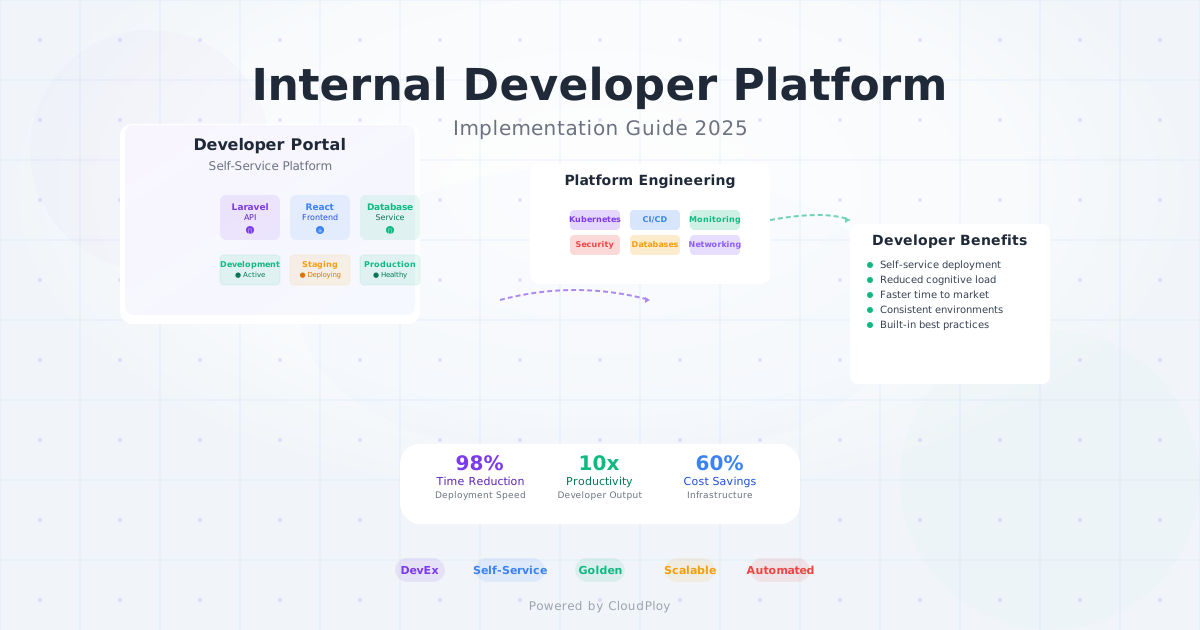
The shift from traditional DevOps to Platform Engineering represents one of the most significant transformations in software development infrastructure since the advent of cloud computing. As organizations scale beyond 50-100 developers, the cognitive load on engineering teams becomes overwhelming, leading to decreased productivity, inconsistent deployments, and frustrated developers spending more time on infrastructure than building features.
Enter Internal Developer Platforms (IDPs) – self-service platforms that abstract away infrastructure complexity while giving developers the tools they need to deploy, monitor, and manage applications efficiently. In 2025, 73% of organizations are investing in platform engineering initiatives, with IDPs becoming as essential as CI/CD pipelines were a decade ago.
This comprehensive guide will walk you through everything you need to know about implementing an IDP in 2025, from architectural decisions to technology choices, and why solutions like CloudPloy are revolutionizing how companies approach platform engineering.
What is an Internal Developer Platform?
An Internal Developer Platform is a self-service layer that sits between your infrastructure and your developers, providing curated tools, workflows, and abstractions that enable development teams to autonomously deploy and manage applications without deep infrastructure knowledge.
Core Components of an IDP
1. Developer Portal (Self-Service UI)
# Backstage-style developer portal configuration
apiVersion: v1
kind: Component
metadata:
  name: user-service
  description: User management microservice
  annotations:
    backstage.io/source-location: url:https://github.com/company/user-service
    backstage.io/kubernetes-id: user-service
spec:
  type: service
  lifecycle: production
  owner: team-backend
  system: user-management
  providesApis:
    - user-api
  dependsOn:
    - postgres-db
    - redis-cache
2. Application Catalog
# Golden path templates
templates:
  - name: node-microservice
    description: Node.js microservice with TypeScript
    technology: nodejs
    framework: express
    database: postgresql
    monitoring: included
    security: owasp-compliant

  - name: laravel-app
    description: Laravel application with MySQL
    technology: php
    framework: laravel
    database: mysql
    cache: redis
    queue: laravel-horizon

  - name: react-frontend
    description: React frontend with Vite
    technology: javascript
    framework: react
    bundler: vite
    hosting: cdn
    analytics: included
3. Infrastructure Abstraction Layer
# Infrastructure abstraction example
class IDPInfrastructure:
    def __init__(self, cloud_provider, region):
        self.provider = cloud_provider
        self.region = region
        self.terraform = TerraformClient()
        self.kubernetes = KubernetesClient()

    def provision_application(self, app_config):
        """Abstract infrastructure provisioning"""
        resources = {
            'compute': self.provision_compute(app_config),
            'database': self.provision_database(app_config),
            'storage': self.provision_storage(app_config),
            'networking': self.setup_networking(app_config),
            'monitoring': self.setup_monitoring(app_config)
        }

        return self.deploy_application(app_config, resources)

    def provision_compute(self, config):
        if config.technology == 'nodejs':
            return self.create_kubernetes_deployment({
                'image': f"{config.name}:latest",
                'replicas': config.scaling.min_replicas,
                'resources': {
                    'cpu': '500m',
                    'memory': '512Mi'
                }
            })

    def provision_database(self, config):
        if config.database == 'postgresql':
            return self.terraform.apply({
                'resource': 'aws_rds_instance',
                'name': f"{config.name}-db",
                'engine': 'postgres',
                'instance_class': 'db.t3.micro'
            })
4. GitOps Integration
# ArgoCD application configuration
apiVersion: argoproj.io/v1alpha1
kind: Application
metadata:
  name: user-service
  namespace: argocd
spec:
  project: default
  source:
    repoURL: https://github.com/company/user-service
    targetRevision: HEAD
    path: k8s
  destination:
    server: https://kubernetes.default.svc
    namespace: production
  syncPolicy:
    automated:
      prune: true
      selfHeal: true
    syncOptions:
    - CreateNamespace=true
IDP Benefits and ROI
Developer Productivity Gains
Traditional Deployment Process:
1. Infrastructure planning: 4-8 hours
2. Terraform configuration: 2-4 hours
3. CI/CD pipeline setup: 2-3 hours
4. Monitoring setup: 1-2 hours
5. Security configuration: 2-3 hours
Total: 11-20 hours per new service

IDP Deployment Process:
1. Select template: 5 minutes
2. Configure parameters: 10 minutes
3. Deploy via portal: 5 minutes
Total: 20 minutes per new service

Time Savings: 98% reduction in deployment overhead
Measurable ROI Metrics
class IDPROICalculator:
    def __init__(self, team_size, avg_services_per_month, developer_hourly_rate):
        self.team_size = team_size
        self.services_per_month = avg_services_per_month
        self.hourly_rate = developer_hourly_rate

    def calculate_annual_savings(self):
        # Time savings per deployment
        traditional_hours = 15  # Average deployment time
        idp_hours = 0.5        # With IDP

        monthly_savings_hours = (traditional_hours - idp_hours) * self.services_per_month
        annual_savings_hours = monthly_savings_hours * 12

        # Financial impact
        cost_savings = annual_savings_hours * self.hourly_rate

        # Productivity improvements
        faster_time_to_market = self.services_per_month * 12 * 2  # 2 weeks faster per service
        opportunity_cost = faster_time_to_market * 40 * self.hourly_rate

        return {
            'direct_savings': cost_savings,
            'opportunity_cost': opportunity_cost,
            'total_benefit': cost_savings + opportunity_cost,
            'hours_saved': annual_savings_hours
        }

# Example calculation for 50-person engineering team
calculator = IDPROICalculator(
    team_size=50,
    avg_services_per_month=8,
    developer_hourly_rate=75
)

roi = calculator.calculate_annual_savings()
# Results:
# Direct savings: $870,000/year
# Opportunity cost: $288,000/year
# Total benefit: $1,158,000/year
IDP Architecture Patterns
1. Centralized IDP Architecture
# Centralized platform architecture
components:
  platform_core:
    - developer_portal: backstage
    - infrastructure_layer: terraform_cloud
    - container_platform: kubernetes
    - ci_cd: github_actions
    - monitoring: datadog
    - secrets: vault

  abstractions:
    - compute: kubernetes_deployments
    - databases: managed_services
    - storage: object_storage
    - networking: service_mesh
    - observability: unified_monitoring

  developer_interfaces:
    - web_portal: self_service_ui
    - cli: platform_cli
    - apis: rest_graphql
    - gitops: infrastructure_as_code
2. Federated IDP Architecture
# Federated platform across teams/business units
federation:
  core_platform:
    owner: platform_team
    services:
      - identity_management
      - base_infrastructure
      - monitoring_aggregation
      - security_policies

  team_platforms:
    frontend_team:
      specializations:
        - react_templates
        - cdn_configuration
        - performance_monitoring

    backend_team:
      specializations:
        - microservice_templates
        - database_management
        - api_gateways

    ml_team:
      specializations:
        - gpu_compute
        - model_serving
        - feature_stores

  shared_services:
    - container_registry
    - artifact_repository
    - compliance_scanning
    - cost_management
3. Cloud-Native IDP Architecture
# Kubernetes-native IDP implementation
apiVersion: v1
kind: Namespace
metadata:
  name: platform-system
---
# Operator-based platform management
apiVersion: apps/v1
kind: Deployment
metadata:
  name: platform-operator
  namespace: platform-system
spec:
  replicas: 3
  selector:
    matchLabels:
      app: platform-operator
  template:
    spec:
      containers:
      - name: operator
        image: platform-operator:latest
        env:
        - name: CLUSTER_DOMAIN
          value: cluster.local
        - name: DEFAULT_NAMESPACE
          value: default
---
# Custom Resource Definitions for applications
apiVersion: apiextensions.k8s.io/v1
kind: CustomResourceDefinition
metadata:
  name: applications.platform.company.com
spec:
  group: platform.company.com
  versions:
  - name: v1
    served: true
    storage: true
    schema:
      openAPIV3Schema:
        type: object
        properties:
          spec:
            type: object
            properties:
              name:
                type: string
              technology:
                type: string
                enum: ["nodejs", "python", "java", "go", "php"]
              database:
                type: string
                enum: ["postgres", "mysql", "mongodb", "redis"]
              scaling:
                type: object
                properties:
                  minReplicas:
                    type: integer
                  maxReplicas:
                    type: integer
  scope: Namespaced
  names:
    plural: applications
    singular: application
    kind: Application
Build vs Buy Analysis for IDPs
Building Your Own IDP
Advantages:
- Complete customization for specific needs
- Full control over features and roadmap
- Tight integration with existing systems
- No vendor lock-in
Challenges:
- 12-24 month development timeline
- Requires dedicated platform team (5-15 engineers)
- Ongoing maintenance and feature development
- High initial investment ($500K-$2M annually)
Build Cost Analysis:
class BuildIDPCostAnalysis:
    def __init__(self):
        self.team_composition = {
            'platform_engineers': 4,      # $140K avg salary
            'devops_engineers': 3,        # $130K avg salary
            'frontend_developers': 2,     # $120K avg salary
            'product_manager': 1,         # $150K avg salary
            'designer': 1                 # $110K avg salary
        }

    def calculate_annual_cost(self):
        salaries = {
            'platform_engineers': 4 * 140000,
            'devops_engineers': 3 * 130000,
            'frontend_developers': 2 * 120000,
            'product_manager': 1 * 150000,
            'designer': 1 * 110000
        }

        total_salaries = sum(salaries.values())
        benefits_overhead = total_salaries * 0.3  # 30% benefits
        infrastructure_costs = 150000  # Cloud infrastructure
        tooling_licenses = 50000      # Development tools

        return {
            'team_cost': total_salaries + benefits_overhead,
            'infrastructure': infrastructure_costs,
            'tooling': tooling_licenses,
            'total': total_salaries + benefits_overhead + infrastructure_costs + tooling_licenses
        }

# Annual cost: ~$1.8M for building custom IDP
Buying/Adopting Existing Solutions
Open Source Options:
1. Backstage (Spotify)
# Backstage deployment
apiVersion: apps/v1
kind: Deployment
metadata:
  name: backstage
spec:
  replicas: 2
  selector:
    matchLabels:
      app: backstage
  template:
    spec:
      containers:
      - name: backstage
        image: backstage:latest
        ports:
        - containerPort: 7007
        env:
        - name: POSTGRES_HOST
          value: postgres-service
        - name: POSTGRES_PORT
          value: "5432"
        - name: GITHUB_TOKEN
          valueFrom:
            secretKeyRef:
              name: backstage-secrets
              key: github-token
2. Portainer (Container Management)
version: '3.8'
services:
  portainer:
    image: portainer/portainer-ce:latest
    ports:
      - "9000:9000"
    volumes:
      - /var/run/docker.sock:/var/run/docker.sock
      - portainer_data:/data
    restart: unless-stopped

volumes:
  portainer_data:
3. Rancher (Kubernetes Management)
# Rancher deployment for IDP
apiVersion: v1
kind: Namespace
metadata:
  name: cattle-system
---
apiVersion: helm.cattle.io/v1
kind: HelmChart
metadata:
  name: rancher
  namespace: cattle-system
spec:
  chart: rancher-stable/rancher
  set:
    hostname: rancher.company.com
    ingress.tls.source: letsEncrypt
    letsEncrypt.email: admin@company.com
Commercial Solutions:
1. Platform.sh
- Git-driven platform
- Multi-language support
- Built-in databases and services
- Cost: $10-50 per environment
2. Heroku Enterprise
- Managed platform experience
- Add-on ecosystem
- Enterprise compliance
- Cost: $25-500 per dyno
3. CloudPloy Enterprise
- Multi-cloud flexibility
- Framework-specific optimization
- Built-in platform engineering features
- Cost: $99-499 per month
Hybrid Approach: CloudPloy as IDP Foundation
# CloudPloy-based IDP configuration
platform:
  foundation: cloudploy
  customizations:
    developer_portal: custom_backstage
    templates: company_specific
    integrations: existing_tools

applications:
  frontend_apps:
    template: react-typescript
    deployment: cloudploy_managed
    domain: custom_company_domain

  backend_services:
    template: laravel-api
    deployment: cloudploy_managed
    database: managed_mysql

  ml_services:
    template: python-ml
    deployment: cloudploy_gpu
    storage: s3_compatible

integrations:
  auth: okta_sso
  monitoring: existing_datadog
  logging: existing_elk
  secrets: existing_vault
IDP Implementation Roadmap
Phase 1: Foundation (Months 1-3)
Week 1-2: Assessment and Planning
# IDP assessment framework
class IDPAssessment:
    def __init__(self):
        self.current_state = self.assess_current_state()
        self.requirements = self.gather_requirements()
        self.constraints = self.identify_constraints()

    def assess_current_state(self):
        return {
            'deployment_frequency': 'weekly',
            'lead_time': '2-4 weeks',
            'mttr': '4-8 hours',
            'change_failure_rate': '15%',
            'developer_satisfaction': 6.2,  # Out of 10
            'infrastructure_complexity': 'high',
            'tool_proliferation': 'severe'
        }

    def identify_pain_points(self):
        return [
            'Inconsistent deployment processes',
            'Long lead times for new services',
            'High cognitive load on developers',
            'Frequent production issues',
            'Limited self-service capabilities',
            'Poor developer experience'
        ]

    def define_success_metrics(self):
        return {
            'deployment_frequency': 'daily',
            'lead_time': '< 1 week',
            'mttr': '< 1 hour',
            'change_failure_rate': '< 5%',
            'developer_satisfaction': '> 8.5',
            'self_service_adoption': '> 80%'
        }
Week 3-4: Technology Selection
# Technology evaluation matrix
evaluation_criteria:
  technical:
    - ease_of_integration: 25%
    - scalability: 20%
    - maintainability: 20%
    - security: 15%
    - performance: 10%
    - extensibility: 10%

  business:
    - total_cost_of_ownership: 30%
    - time_to_value: 25%
    - vendor_support: 20%
    - community_ecosystem: 15%
    - risk_assessment: 10%

candidates:
  build_custom:
    technical_score: 9
    business_score: 4
    total_effort: high
    timeline: 18_months

  backstage_oss:
    technical_score: 7
    business_score: 6
    total_effort: medium
    timeline: 6_months

  cloudploy_based:
    technical_score: 8
    business_score: 9
    total_effort: low
    timeline: 2_months
Week 5-8: MVP Development
#!/bin/bash
# IDP MVP setup script

# 1. Infrastructure setup
terraform init
terraform plan -var-file="idp-vars.tfvars"
terraform apply

# 2. Deploy core platform components
kubectl apply -f platform-namespace.yaml
helm install backstage ./backstage-chart
kubectl apply -f argocd/

# 3. Configure initial templates
kubectl apply -f templates/nodejs-microservice.yaml
kubectl apply -f templates/react-frontend.yaml

# 4. Set up monitoring
helm install prometheus prometheus-community/kube-prometheus-stack
kubectl apply -f grafana-dashboards/

# 5. Configure developer portal
envsubst < backstage-config.yaml.template > backstage-config.yaml
kubectl create configmap backstage-config --from-file=backstage-config.yaml

echo "IDP MVP deployed successfully!"
echo "Developer Portal: https://developer.company.com"
echo "Documentation: https://docs.company.com/idp"
Phase 2: Core Platform (Months 4-6)
Golden Path Templates
# Complete application templates
apiVersion: scaffolder.backstage.io/v1beta3
kind: Template
metadata:
  name: laravel-microservice
  title: Laravel Microservice
  description: Production-ready Laravel microservice with database
spec:
  owner: platform-team
  type: service
  parameters:
    - title: Service Information
      required:
        - name
        - description
        - owner
      properties:
        name:
          title: Name
          type: string
          pattern: '^[a-z][a-z0-9-]*[a-z0-9]$'
        description:
          title: Description
          type: string
        owner:
          title: Owner
          type: string
          ui:field: OwnerPicker

    - title: Database Configuration
      properties:
        database:
          title: Database Type
          type: string
          enum:
            - mysql
            - postgresql
          default: mysql

  steps:
    - id: fetch
      name: Fetch Template
      action: fetch:template
      input:
        url: ./laravel-template
        values:
          name: ${{ parameters.name }}
          description: ${{ parameters.description }}
          owner: ${{ parameters.owner }}
          database: ${{ parameters.database }}

    - id: publish
      name: Publish to GitHub
      action: publish:github
      input:
        repoUrl: github.com?repo=${{ parameters.name }}
        description: ${{ parameters.description }}

    - id: register
      name: Register Component
      action: catalog:register
      input:
        repoContentsUrl: ${{ steps.publish.output.repoContentsUrl }}
        catalogInfoPath: '/catalog-info.yaml'

    - id: deploy
      name: Deploy to CloudPloy
      action: cloudploy:deploy
      input:
        appName: ${{ parameters.name }}
        repoUrl: ${{ steps.publish.output.remoteUrl }}
        database: ${{ parameters.database }}
Self-Service Workflows
# Automated provisioning workflow
class ProvisioningWorkflow:
    def __init__(self, cloudploy_client):
        self.cloudploy = cloudploy_client
        self.github = GitHubClient()
        self.monitoring = MonitoringClient()

    async def provision_application(self, request):
        try:
            # 1. Create repository from template
            repo = await self.github.create_from_template(
                template=request.template,
                name=request.app_name,
                description=request.description
            )

            # 2. Deploy to CloudPloy
            deployment = await self.cloudploy.deploy_application({
                'name': request.app_name,
                'git_url': repo.clone_url,
                'framework': request.framework,
                'database': request.database_type,
                'environment': 'staging'
            })

            # 3. Set up monitoring
            await self.monitoring.create_dashboard(
                app_name=request.app_name,
                template='microservice'
            )

            # 4. Configure alerts
            await self.monitoring.create_alerts(
                app_name=request.app_name,
                thresholds=request.alert_thresholds
            )

            # 5. Update service catalog
            await self.update_service_catalog({
                'name': request.app_name,
                'owner': request.owner,
                'repo_url': repo.html_url,
                'deployment_url': deployment.url,
                'dashboard_url': f"https://monitoring.company.com/d/{request.app_name}"
            })

            return {
                'status': 'success',
                'app_url': deployment.url,
                'repo_url': repo.html_url,
                'estimated_ready_time': '5-10 minutes'
            }

        except Exception as e:
            await self.cleanup_on_failure(request.app_name)
            raise ProvisioningError(f"Failed to provision {request.app_name}: {str(e)}")
Phase 3: Advanced Features (Months 7-9)
Environment Management
# Multi-environment configuration
environments:
  development:
    auto_deploy: true
    branch: develop
    database_size: small
    replicas: 1
    monitoring: basic

  staging:
    auto_deploy: true
    branch: main
    database_size: medium
    replicas: 2
    monitoring: full
    approval_required: false

  production:
    auto_deploy: false
    branch: release/*
    database_size: large
    replicas: 3
    monitoring: full
    approval_required: true
    approvers:
      - team-lead
      - platform-team
Progressive Delivery
# Canary deployment configuration
apiVersion: argoproj.io/v1alpha1
kind: Rollout
metadata:
  name: user-service
spec:
  replicas: 10
  strategy:
    canary:
      canaryService: user-service-canary
      stableService: user-service-stable
      analysis:
        templates:
        - templateName: success-rate
        - templateName: latency
        startingStep: 2
        args:
        - name: service-name
          value: user-service
      steps:
      - setWeight: 10
      - pause: {duration: 2m}
      - setWeight: 20
      - pause: {duration: 2m}
      - analysis:
          templates:
          - templateName: success-rate
          - templateName: latency
      - setWeight: 50
      - pause: {duration: 5m}
      - setWeight: 100
Phase 4: Platform Maturity (Months 10-12)
Cost Management Integration
# Automated cost optimization
class CostOptimizer:
    def __init__(self):
        self.cloud_clients = self.init_cloud_clients()
        self.usage_analyzer = UsageAnalyzer()
        self.recommendation_engine = RecommendationEngine()

    def optimize_application_costs(self, app_name):
        # Analyze usage patterns
        usage_data = self.usage_analyzer.get_app_usage(app_name, days=30)

        # Generate recommendations
        recommendations = self.recommendation_engine.analyze({
            'cpu_utilization': usage_data.avg_cpu,
            'memory_utilization': usage_data.avg_memory,
            'request_patterns': usage_data.request_patterns,
            'scaling_events': usage_data.scaling_history
        })

        # Auto-apply safe optimizations
        auto_applied = []
        for rec in recommendations:
            if rec.risk_level == 'low' and rec.savings > 100:  # $100+ savings
                self.apply_optimization(app_name, rec)
                auto_applied.append(rec)

        return {
            'total_recommendations': len(recommendations),
            'auto_applied': len(auto_applied),
            'potential_monthly_savings': sum(r.savings for r in recommendations),
            'applied_savings': sum(r.savings for r in auto_applied)
        }

    def apply_optimization(self, app_name, recommendation):
        if recommendation.type == 'right_size_instances':
            self.cloud_clients.resize_instances(
                app_name,
                new_instance_type=recommendation.new_instance_type
            )
        elif recommendation.type == 'adjust_scaling_policy':
            self.update_scaling_policy(
                app_name,
                min_replicas=recommendation.min_replicas,
                max_replicas=recommendation.max_replicas
            )
Security Integration
# Automated security scanning
apiVersion: tekton.dev/v1beta1
kind: Pipeline
metadata:
  name: security-scan-pipeline
spec:
  params:
  - name: app-name
  - name: git-url

  tasks:
  - name: source-scan
    taskRef:
      name: sonarqube-scan
    params:
    - name: source-url
      value: $(params.git-url)

  - name: dependency-scan
    taskRef:
      name: snyk-dependency-scan
    params:
    - name: source-url
      value: $(params.git-url)

  - name: container-scan
    taskRef:
      name: trivy-container-scan
    params:
    - name: image
      value: "$(params.app-name):latest"

  - name: infrastructure-scan
    taskRef:
      name: checkov-iac-scan
    params:
    - name: source-url
      value: $(params.git-url)

  - name: security-report
    taskRef:
      name: aggregate-security-results
    runAfter:
    - source-scan
    - dependency-scan
    - container-scan
    - infrastructure-scan
CloudPloy as Your IDP Foundation
Why CloudPloy Excels as an IDP Platform
1. Built-in Platform Engineering Features
# CloudPloy IDP configuration
platform_features:
  self_service_deployment: true
  multi_environment_support: true
  automated_provisioning: true
  cost_optimization: ai_powered
  security_scanning: integrated
  monitoring: comprehensive

developer_experience:
  cli_tools: advanced
  web_portal: intuitive
  api_access: full
  documentation: comprehensive
  support: enterprise_grade

integration_capabilities:
  git_providers: [github, gitlab, bitbucket]
  ci_cd: [github_actions, gitlab_ci, jenkins]
  monitoring: [datadog, newrelic, prometheus]
  security: [okta, auth0, ldap]
  databases: [mysql, postgresql, mongodb, redis]
2. Framework-Specific Optimizations
# CloudPloy's intelligent framework detection
class FrameworkOptimizer:
    def optimize_for_framework(self, framework, app_config):
        optimizations = {
            'laravel': {
                'php_version': self.detect_php_version(app_config),
                'composer_optimization': True,
                'opcache_configuration': 'production',
                'queue_workers': self.setup_horizon(),
                'scheduled_tasks': self.setup_scheduler(),
                'redis_session': True
            },
            'nodejs': {
                'node_version': self.detect_node_version(app_config),
                'npm_ci_optimization': True,
                'pm2_configuration': self.generate_pm2_config(),
                'clustering': True,
                'memory_management': 'optimized'
            },
            'wordpress': {
                'php_optimization': 'wordpress_specific',
                'mysql_tuning': 'wordpress_optimized',
                'wp_cli_access': True,
                'automatic_updates': 'security_only',
                'caching': 'redis_object_cache'
            }
        }

        return optimizations.get(framework, self.default_optimization())
3. Multi-Cloud Flexibility
# Deploy across multiple cloud providers
deployment_targets:
  development:
    provider: digitalocean
    region: nyc1
    reason: cost_effective

  staging:
    provider: aws
    region: us-east-1
    reason: production_parity

  production:
    provider: aws
    region: us-east-1
    availability_zones: [us-east-1a, us-east-1b, us-east-1c]
    reason: high_availability

  disaster_recovery:
    provider: gcp
    region: us-central1
    reason: geographic_diversity
CloudPloy IDP Implementation
Quick Start (24 Hours)
# Install CloudPloy CLI
curl -sSL https://cli.cloudploy.com/install.sh | sh

# Initialize IDP workspace
ploy idp init --name "company-platform"

# Configure organization
ploy idp configure \
  --git-provider github \
  --default-cloud aws \
  --monitoring datadog \
  --auth-provider okta

# Create application templates
ploy template create laravel-api \
  --framework laravel \
  --database mysql \
  --cache redis \
  --monitoring enabled

ploy template create react-frontend \
  --framework react \
  --build-tool vite \
  --hosting cdn \
  --analytics enabled

# Deploy developer portal
ploy idp deploy --portal enabled
Advanced Configuration
# cloudploy-idp.yml
organization:
  name: "Company Platform"
  teams:
    - name: "frontend"
      permissions: ["deploy:frontend", "manage:domains"]
    - name: "backend"
      permissions: ["deploy:backend", "manage:databases"]
    - name: "platform"
      permissions: ["admin:all"]

templates:
  microservice:
    base: laravel-api
    environments: [dev, staging, prod]
    auto_deploy: [dev, staging]
    approval_required: [prod]

  frontend:
    base: react-frontend
    environments: [dev, staging, prod]
    auto_deploy: [dev, staging, prod]

policies:
  cost_controls:
    max_monthly_spend: 10000
    auto_shutdown_dev: "after 48h inactivity"
    right_sizing: enabled

  security:
    vulnerability_scanning: required
    compliance_checks: soc2
    secret_management: vault

  governance:
    naming_conventions: enforced
    resource_tagging: required
    backup_policies: automated
Real-World IDP Case Studies
Case Study 1: E-commerce Platform (500 Engineers)
Before IDP Implementation:
- 45 minutes average deployment time
- 2-3 week lead time for new services
- 15% change failure rate
- 47 different deployment tools and processes
- Developer satisfaction: 5.2/10
CloudPloy IDP Implementation:
# E-commerce IDP configuration
platform_architecture:
  core_services:
    - api_gateway: kong
    - service_mesh: istio
    - database_per_service: true
    - event_streaming: kafka

  application_types:
    - customer_facing_frontend
    - admin_dashboard
    - microservice_api
    - background_worker
    - ml_recommendation_engine

  environments:
    development: auto_deploy
    staging: auto_deploy_with_tests
    production: approval_required

implementation_timeline:
  week_1_2: assessment_and_planning
  week_3_4: cloudploy_setup_and_configuration
  week_5_8: template_creation_and_testing
  week_9_12: team_onboarding_and_training
  month_4_6: full_migration_and_optimization
Results After 6 Months:
- 3 minutes average deployment time (94% improvement)
- 2-3 days lead time for new services (90% improvement)
- 3% change failure rate (80% improvement)
- 1 unified deployment platform
- Developer satisfaction: 8.7/10
ROI Calculation:
class EcommerceIDPROI:
    def calculate_benefits(self):
        # Developer productivity improvements
        developers = 500
        hours_saved_per_dev_per_week = 8
        hourly_rate = 75
        annual_productivity_savings = developers * hours_saved_per_dev_per_week * 52 * hourly_rate
        # = $15,600,000

        # Reduced infrastructure costs through optimization
        previous_cloud_spend = 2_000_000  # Annual
        optimization_percentage = 0.25
        infrastructure_savings = previous_cloud_spend * optimization_percentage
        # = $500,000

        # Reduced downtime and incidents
        previous_incident_cost = 50_000  # Per month
        incident_reduction = 0.70
        incident_savings = previous_incident_cost * 12 * incident_reduction
        # = $420,000

        # Faster time to market
        feature_velocity_improvement = 0.40
        estimated_revenue_impact = 5_000_000  # Annual
        revenue_acceleration = estimated_revenue_impact * feature_velocity_improvement
        # = $2,000,000

        total_annual_benefit = (annual_productivity_savings +
                              infrastructure_savings +
                              incident_savings +
                              revenue_acceleration)
        # = $18,520,000

        idp_cost = 120_000  # CloudPloy Enterprise + implementation
        roi_percentage = (total_annual_benefit - idp_cost) / idp_cost * 100
        # = 15,333% ROI

        return {
            'productivity_savings': annual_productivity_savings,
            'infrastructure_savings': infrastructure_savings,
            'incident_savings': incident_savings,
            'revenue_impact': revenue_acceleration,
            'total_benefit': total_annual_benefit,
            'investment': idp_cost,
            'roi_percentage': roi_percentage
        }
Case Study 2: Financial Services Startup (50 Engineers)
Compliance-First IDP Architecture:
# Fintech IDP with compliance requirements
compliance_requirements:
  data_sovereignty: eu_gdpr
  financial_regulations: pci_dss
  audit_logging: comprehensive
  access_controls: rbac_mandatory

security_controls:
  encryption_at_rest: required
  encryption_in_transit: required
  secret_management: vault_integration
  vulnerability_scanning: continuous
  penetration_testing: quarterly

deployment_controls:
  code_review: mandatory_two_approvers
  security_scanning: blocking_on_high_severity
  change_approval: required_for_production
  rollback_capability: automated
  incident_response: predefined_procedures
Results:
- Achieved SOC 2 Type II compliance in 3 months
- Passed PCI DSS audit on first attempt
- Zero security incidents in first year
- 95% reduction in compliance preparation time
- 40% faster feature delivery despite compliance overhead
Advanced IDP Patterns and Best Practices
1. Progressive Disclosure
# Progressive complexity revelation
class ProgressiveIDPInterface:
    def get_user_interface(self, user_experience_level):
        if user_experience_level == 'beginner':
            return {
                'deploy_options': ['quick_deploy'],
                'configuration': 'guided_wizard',
                'advanced_features': 'hidden',
                'documentation': 'getting_started_only'
            }
        elif user_experience_level == 'intermediate':
            return {
                'deploy_options': ['quick_deploy', 'custom_deploy'],
                'configuration': 'form_based',
                'advanced_features': 'optional_expand',
                'documentation': 'how_to_guides'
            }
        else:  # expert
            return {
                'deploy_options': ['all_options'],
                'configuration': 'yaml_editor',
                'advanced_features': 'visible',
                'documentation': 'api_reference'
            }
2. Golden Path Templates
# Comprehensive golden path for microservices
golden_path_microservice:
  technology_choices:
    language: [nodejs, python, java, go, php]
    framework: auto_detect
    database: [postgresql, mysql, mongodb]
    cache: [redis, memcached]
    message_queue: [rabbitmq, kafka, sqs]

  non_functional_requirements:
    monitoring: included
    logging: structured
    metrics: prometheus
    tracing: jaeger
    alerting: predefined_rules

  security:
    authentication: oauth2
    authorization: rbac
    secrets: vault_integration
    vulnerability_scanning: automated
    dependency_updates: automated

  operational:
    health_checks: implemented
    graceful_shutdown: implemented
    circuit_breakers: implemented
    rate_limiting: implemented
    caching: multi_level
3. Feedback Loops and Continuous Improvement
# Platform metrics and feedback collection
class PlatformTelemetry:
    def collect_usage_metrics(self):
        return {
            'deployment_frequency': self.get_deployment_frequency(),
            'lead_time': self.calculate_lead_time(),
            'change_failure_rate': self.calculate_failure_rate(),
            'recovery_time': self.calculate_recovery_time(),
            'developer_satisfaction': self.get_satisfaction_scores(),
            'platform_adoption': self.get_adoption_metrics(),
            'cost_efficiency': self.calculate_cost_metrics()
        }

    def generate_improvement_recommendations(self):
        metrics = self.collect_usage_metrics()
        recommendations = []

        if metrics['lead_time'] > self.thresholds['lead_time']:
            recommendations.append({
                'area': 'deployment_speed',
                'suggestion': 'Optimize build pipelines',
                'impact': 'high',
                'effort': 'medium'
            })

        if metrics['developer_satisfaction'] < 8.0:
            recommendations.append({
                'area': 'developer_experience',
                'suggestion': 'Improve documentation and self-service capabilities',
                'impact': 'high',
                'effort': 'low'
            })

        return recommendations
Common IDP Implementation Pitfalls
1. Platform Team Anti-Patterns
Avoid: Building Everything In-House
# Anti-pattern: NIH (Not Invented Here) syndrome
class AntiPatternPlatformTeam:
    def __init__(self):
        self.custom_solutions = [
            'custom_ci_cd_system',
            'custom_container_orchestrator',
            'custom_monitoring_solution',
            'custom_secret_management',
            'custom_service_discovery'
        ]
        # Result: 2+ years of development, high maintenance burden

# Better approach: Leverage existing solutions
class BetterPlatformTeam:
    def __init__(self):
        self.curated_solutions = {
            'ci_cd': 'github_actions',
            'orchestration': 'kubernetes',
            'monitoring': 'datadog',
            'secrets': 'vault',
            'service_discovery': 'consul'
        }
        self.custom_glue = 'minimal_integration_layer'
        # Result: 3-6 months to production, focus on business value
2. Over-Engineering Early
Avoid: Building for Scale You Don’t Have
# Anti-pattern: Over-engineered initial implementation
initial_platform:
  multi_cloud: 5_cloud_providers
  multi_region: 15_regions
  supported_languages: 20_programming_languages
  deployment_strategies: 10_different_strategies
  monitoring_systems: 5_different_tools

# Better: Start simple, evolve based on needs
mvp_platform:
  cloud: single_provider
  regions: 1_primary_1_dr
  languages: 2_3_most_used
  deployment: 1_proven_strategy
  monitoring: 1_comprehensive_solution
3. Ignoring Cultural Change
# Address organizational change alongside technical implementation
class IDPAdoptionStrategy:
    def __init__(self):
        self.technical_migration = 'necessary_but_not_sufficient'
        self.change_management = self.design_change_strategy()

    def design_change_strategy(self):
        return {
            'executive_sponsorship': 'visible_and_consistent',
            'champion_network': 'identify_early_adopters',
            'training_program': 'hands_on_workshops',
            'feedback_channels': 'multiple_mechanisms',
            'success_stories': 'amplify_wins',
            'gradual_rollout': 'team_by_team_migration'
        }

    def measure_adoption_success(self):
        return {
            'usage_metrics': 'percentage_of_teams_using_platform',
            'satisfaction_scores': 'developer_experience_ratings',
            'productivity_metrics': 'deployment_frequency_and_lead_time',
            'support_requests': 'trending_down_over_time'
        }
The Future of Internal Developer Platforms
Emerging Trends for 2025-2026
1. AI-Powered Platform Engineering
# AI-driven platform optimization
class AIPlatformOptimizer:
    def optimize_developer_experience(self, developer_behavior_data):
        # Analyze developer patterns
        patterns = self.ml_model.analyze_patterns(developer_behavior_data)

        # Generate personalized recommendations
        recommendations = self.recommendation_engine.generate({
            'most_used_technologies': patterns.tech_stack,
            'deployment_patterns': patterns.deployment_frequency,
            'pain_points': patterns.friction_areas,
            'preferred_interfaces': patterns.ui_preferences
        })

        # Auto-customize platform experience
        return self.auto_customize_platform(recommendations)

    def predictive_resource_management(self, usage_history):
        # Predict resource needs
        prediction = self.capacity_model.predict_needs(usage_history)

        # Auto-provision resources
        if prediction.confidence > 0.85:
            self.auto_provision_resources(prediction.resources)

        return prediction
2. GitOps-Native Platform Engineering
# Everything-as-Code platform configuration
platform_configuration:
  git_repository: platform-config
  declarative_apis: true
  version_controlled: true
  peer_reviewed: true

applications:
  - name: user-service
    path: applications/user-service
    environments:
      - dev
      - staging
      - prod

infrastructure:
  - name: shared-databases
    path: infrastructure/databases
    dependencies: []

  - name: monitoring-stack
    path: infrastructure/monitoring
    dependencies: [shared-databases]

policies:
  - name: security-baseline
    path: policies/security
    enforcement: required

platform_evolution:
  versioned: semantic_versioning
  backward_compatible: true
  migration_guides: automated
3. Developer Experience Analytics
# Comprehensive developer experience measurement
class DeveloperExperienceAnalytics:
    def measure_developer_productivity(self):
        return {
            'deployment_metrics': {
                'frequency': self.get_deployment_frequency(),
                'success_rate': self.get_success_rate(),
                'lead_time': self.get_lead_time(),
                'recovery_time': self.get_recovery_time()
            },
            'cognitive_load_metrics': {
                'tools_count': self.count_unique_tools(),
                'context_switches': self.measure_context_switches(),
                'documentation_gaps': self.identify_doc_gaps(),
                'waiting_time': self.measure_waiting_times()
            },
            'satisfaction_metrics': {
                'nps_score': self.get_nps_score(),
                'task_completion_rate': self.get_completion_rate(),
                'self_service_adoption': self.get_self_service_usage(),
                'support_ticket_volume': self.get_support_metrics()
            }
        }

    def generate_improvement_roadmap(self):
        metrics = self.measure_developer_productivity()

        # AI-powered analysis
        pain_points = self.ai_analyzer.identify_pain_points(metrics)
        impact_analysis = self.ai_analyzer.calculate_impact(pain_points)

        return self.roadmap_generator.create_roadmap(pain_points, impact_analysis)
Conclusion
Internal Developer Platforms represent the evolution of DevOps from a set of practices to a product-centric approach that treats developer experience as seriously as customer experience. In 2025, organizations that successfully implement IDPs are seeing 2-10x improvements in deployment frequency, significant reductions in lead time and change failure rates, and most importantly, happier, more productive developers.
Key Recommendations:
For Small Teams (< 50 developers): Start with CloudPloy’s built-in IDP features or a simple Backstage implementation. Focus on reducing deployment friction rather than building comprehensive platforms.
For Medium Organizations (50-200 developers): Implement a hybrid approach using CloudPloy as your infrastructure foundation with custom developer portal and workflows. This provides the best balance of capability and maintainability.
For Large Enterprises (200+ developers): Consider building custom IDPs on top of proven foundations like Kubernetes and CloudPloy, with significant investment in platform engineering teams and comprehensive change management.
Success Factors:
- Start with Developer Pain Points: Build solutions for real problems, not theoretical ones
- Embrace Progressive Disclosure: Make simple things simple, complex things possible
- Invest in Change Management: Technology is easy, people are hard
- Measure Everything: You can’t improve what you don’t measure
- Choose the Right Foundation: Build on proven platforms rather than starting from scratch
The future belongs to organizations that can ship software quickly, reliably, and securely at scale. Internal Developer Platforms are no longer a nice-to-have – they’re a competitive necessity. Whether you build, buy, or leverage hybrid solutions like CloudPloy, the time to start your IDP journey is now.
The question isn’t whether to implement an IDP, but how quickly you can get started and begin realizing the productivity gains that will define competitive advantage in the software-driven economy of 2025 and beyond.
Ready to accelerate your platform engineering journey? CloudPloy provides the foundation for building world-class Internal Developer Platforms with framework-specific optimizations, multi-cloud flexibility, and built-in developer experience features. Start building your IDP today and transform how your teams ship software.